Showing posts sorted by date for query ege. Sort by relevance Show all posts

Sunday, 14 December 2025

'Mirmellus Arnandi'

Among the bibles broken up by Otto Ege and/or Philip Duschnes is one often called the bible of 'Mirmellus Arnandi' (of which an example is shown above), produced in Paris c. 1300. Leaves were no. 14 in the famous Ege portfolio of Fifty Original Leaves.

The bible derives its name from the description of a cache of 210 of leaves sold at Sotheby's, 11 December 1984, lot 39: some of the leaves have erased inscriptions in formal gothic script the lower margin, and from those that remain partially legible, Christopher de Hamel concluded that the bible was 'Bequeathed to a Dominican Convent in 1450 by Mirmellus Arnandi, lawyer and judge', e.g. 'Ego mirmelus [sic] arnandi legum doctor et [...] Judex' on the leaf with the beginning of the book of Nahum.

Sunday, 23 July 2023

Two More Erik von Scherling Catalogues Online


In 2015 I wrote a blogpost about the Dutch dealer Erik von Scherling, including an attempt to list all his known catalogues, especially the series with the title "Rotulus".
 
At my request, and through the kindness of Candice C. Brown at Duke University Libraries, two more of his catalogues have now been digitized, and are available online at Archive.org.

Saturday, 27 May 2023

Otto Ege's Terence: An Addendum


Last weekend I posted about Otto Ege's manuscript of Terence's Comedies. I reproduced at the top of the page an image of a leaf in a private collection in California that I was able to examine a few weeks ago, thanks to the very kind hospitality of the owner. After he read my post, he contacted me to tactfully draw my attention to the fact that I seemed to have made an oversight.

Sunday, 21 May 2023

Otto Ege's Terence


Private collection, California

Leaves from some of Otto Ege's manuscripts are very easily recognised. He did not sell many leaves of manuscripts written in Humanistic script, for example, and among these, his copy of Terence's Comedies is distinctive (an example is shown above).

Sunday, 9 October 2022

Otto Ege's Limoges Missal (HL38)


The early 20th-century provenance of Otto Ege's Limoges Missal, leaves of which were no. 38 in his posthumous portfolio of Fifty Original Leaves, is already well established. Scott Gwara (Otto Ege's Manuscripts, 2013, HL38) records sales at Sotheby's, 26 March 1917, lot 799; American Art/Anderson Galleries, 20 January 1925, lot 288; and American Art/Anderson Galleries, 8 February 1926, lot 288.

Sunday, 2 October 2022

Another Leaf of the Arrivabene Eusebius


Thanks to the kindness of Steven Galbraith of the Rochester Institute of Technology, I have just received images of some of the leaves I was unable to see in person while in Rochester this summer. They have all sorts of interesting items, but one in particular caught my attention, a detail of which is shown above.

A few years ago wrote a blogpost about "An Unnoticed Arrivabene Leaf at the Newberry Library" (here); it concerns one of two leaves formerly owned by Ernst F. Detterer (1888-1947) of Chicago, friend of Otto Ege, and now at the Newberry. I was unable to locate the second leaf, but I think it must be the one now at Rochester.

Saturday, 10 September 2022

More Ege Acquisitions from Dawson's Book Shop

Last week we looked at a manuscript sold by Dawson's Book Shop of Los Angeles, and broken up by Otto Ege (or perhaps Philip Duschnes). Today we'll look at a few more.

For the catalogue of French manuscripts in the collection of Bob McCarthy I traced eleven leaves with historiated initials from a Parisian Bible of about the 1330s  (of which a detail is shown above), and about sixteen more without historiated initials:

Saturday, 3 September 2022

Dawson's of Los Angeles and Otto Ege's Aquinas (HL40)

[Photo by Mildred Budney]

One of the better-known and easily recognised ex-Ege manuscripts was a copy of Thomas Aquinas's Commentary on Peter Lombard's Sentences, Book I, of which a leaf is shown above. Leaves from the manuscript are included as no. 40 in Ege's most famous portfolio: Fifty Original Leaves of Medieval Manuscripts, issued by his widow two years after his death in 1951.

Although Philip Duschnes of New York was apparently the first dealer to offer single leaves of the manuscript, it is likely that Ege was responsible for breaking it up: not only did he have enough leaves to include in his 1942(?) portfolio of Original Leaves from Famous Books, Nine Centuries as well as the posthumous Fifty Original Leaves portfolios, but a cache of 32 leaves from his collection was sold by his heirs at Sotheby's in 1985. The finest leaf of the manuscript was retained by the Ege heirs as part of the "Family Album", acquired by the Beinecke Library several years ago; if Duschnes had broken up the volume, he would doubtless have sold this leaf.

I wrote a blogpost about the provenance of the manuscript last year. We know that the volume was still intact in 1925-26 when offered for sale by the bookselling firm of Davis & Orioli, based in Florence and London. It was also still intact when owned by an "Unidentified American bookseller", but was broken by 1941, when Duschnes offered leaves in his Catalogue 48.

Saturday, 28 May 2022

Leaves from Cicero, De oratore, written in 1453

University of Rochester, D.460 1353-001 [Source]

In preparation for a manuscripts safari this summer, I am combing through online library catalogues of collections in New York state for manuscripts of interest. The Rush Rhees Library of the University of Rochester has an online handlist of its medieval and early modern manuscripts, for example, and one that particularly caught my eye is this:

 
The precise date "1353", suggests that the cataloguer knew something about the parent manuscript, and reminded me of Otto Ege's Dominican Missal dated 1353. As luck would have it, this is one of only two medieval manuscripts for which images are available online, so I was able to have a look; a whole-page view is shown above. 

Sunday, 20 March 2022

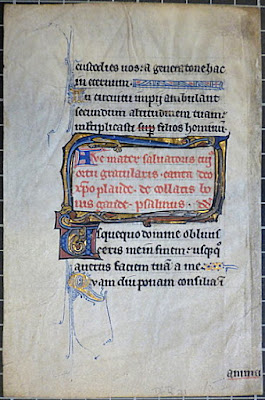
Otto Ege's Psalter with 'Aves' (HL116)

Many years ago, I worked on a group of early 13th-century English Psalters, some of which include a  hymn or series of prayers to the Virgin in which each stanza starts with the word "Ave". So I took special notice when, in 2014, I encountered at the Philadelphia Museum of Art a leaf from a later 13th-century (c.1270) Franco-Flemish example, with the "Ave" stanza before each Psalm, curiously enframed in illuminated ornament, as in the image above.

Saturday, 29 January 2022

A Ghent Breviary (Ege HL 18)

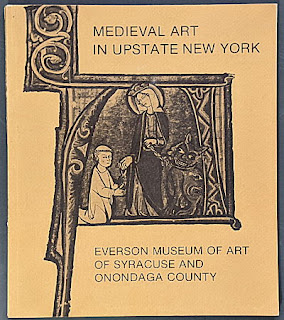
I was recently browsing the 1974 exhibition catalogue of Medieval Art in Upstate New York:

It reminded me that, in addition to an Otto Ege portfolio of "Fifty Original Leaves" (digitized here), the Buffalo and Erie County Public Library has some other interesting leaves and codices. I emailed the Library, and Amy J. Pickard, the Rare Book Curator, kindly and very promptly sent me reference images of all the leaves I enquired about.

In addition to a leaf from Ege HL 18 [1] in the "Fifty Original Leaves" portfolio (here), the Library has another leaf from the same manuscript, which we will come to shortly. The 90-leaf carcass of the parent volume was offered (but was apparently unsold) as part of the Ege estate at Sotheby's, 26 November 1985, lot 59 [2], and from this large portion it was possible to attribute the manuscript to "Flanders, possibly Ghent", because the litany includes numerous other Flemish saints, including Livinus and Bavo (who were important in Ghent) highly-placed.

Saturday, 16 October 2021

Otto Ege's Armenian Lectionary Dated "1121"

[Source]

I cannot read languages written in non-Latin alphabets, such as Hebrew, Greek, Syriac, and Armenian, so I will only attempt to catalogue them if I have help from a specialist. I do, however, enounter them periodically. Ethiopian codices are fairly popular with private collectors, for example, because a complete codex (usually 19th-century, but still medieval in character) can be bought for the price of a single medieval Western illuminated leaf, and because the wood boards of the bindings are often not covered, leaving the spine and sewing structure clearly visible: they therefore make very good teaching tools.

I encounter with some frequency (in person or online) leaves from an Armenian Lectionary dispersed by Otto Ege (as shown above). Leaves of it were not included in his famous portfolio of Fifty Original Leaves, but they were in three of his earlier portfolios: Original Leaves from Famous Bibles: Nine centuries, 1121 A.D. - 1935 A.D., 'Series A' issued in 1936, in an edition of 200, and 'Series B' issued in 1938, in an edition of 100; and Fifteen Original Oriental Leaves of Six Centuries issued in [1952] in an edition of 40 copies [1]. If you meet with a leaf of an Armenian manuscript on paper, written in two columns of 33 lines, there is a good chance that it comes from this manuscipt.

Sunday, 18 July 2021

The Backs and Edges of Cuttings

Regular readers will know how often the backs of leaves and cuttings provide vital information. There may be a significant attribution (e.g. "From the Cathedral at Como"); a direct indication of a former owner (e.g. notes initialled "TMW" by Thomas Miller Whitehead); an auction lot number that allows it to be identified in a sale catalogue; text and/or music that allows the ambiguous subject-matter of an initial to be identified; or traces of a characteristic type of adhesive mounting-tape, that reveals it to have been sold by Otto Ege.

This week, I started to write a note about some interesting ideas presented by Christopher de Hamel in the Introduction to the recently published catalogue of the Burke Collection [1], but I quickly became side-tracked by his discussion of a cutting from Santa Maria degli Angeli, shown above.

Sunday, 4 July 2021

The Zion Collection

In the 1990s I catalogued a 13th-century Bible with varied and interesting indications of provenance, including an inscription "Zion MS. 2" on the first flyleaf, as shown above. Here it is in context:


Saturday, 29 May 2021

Otto Ege's 12th-Century Italian Gospel Lectionary

[Source]

Sotheby's currently have an online sale including more than thirty single leaves from Otto Ege manuscripts, including a leaf from his well-known 12th-century Italian Gospel Lectionary, shown above. I helped to catalogue the sale, giving me a reason to reconsider the parent manuscript, which I have not really thought about since a blogpost in 2015.

The main purpose of my 2015 post was to share a 1937 description of the manuscript before it was was disbound and dispersed, but I did not pursue this to its logical conclusion, to see how much we could deduce about its provenance and contents from the old description and available images.

Saturday, 22 May 2021

Otto Ege's Copy of Thomas Aquinas on Peter Lombard's Sentences


One of the most easily recognisable manuscripts dispersed by Otto Ege was a copy of Thomas Aquinas's Commentary on Peter Lombard's Sentences, Book I. Typical leaves look like the one above.

Saturday, 22 February 2020

An Exhibition in Richmond, Virginia, in 1943

[Source]

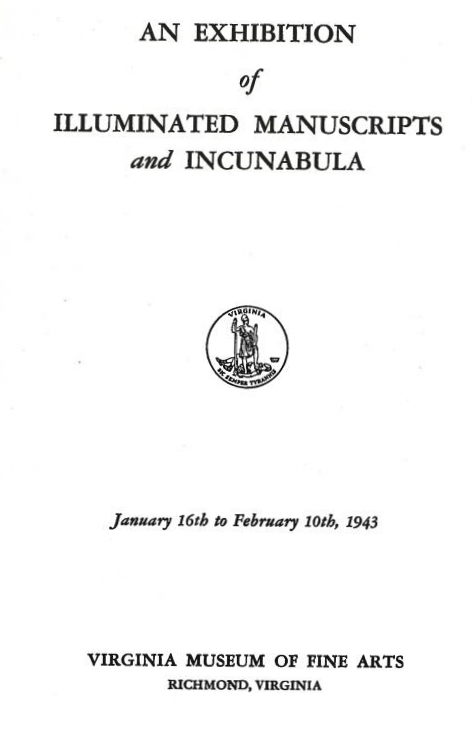
A few years ago I was trying to find out what leaves and cuttings are in Virginia, so I contacted the Virginia Museum of Fine Arts about an exhibition catalogue that seemed not to be available in any London library:
The archivist Courtney Yevich Tkacz very kindly sent me a scan of it. (It has since been put online here). Looking at it again this week, I noticed several connections with recent blogs.

Saturday, 25 January 2020

Unrecognised Brölemann Provenances


As mentioned in an earlier post, I have been attempting to create a list of the Brölemann manuscripts, with a detailed account of their pre- and post-Brölemann provenances. It is now nearly 100 pages long, and I hope to share it fairly soon.

This exercise has been interesting for lots of reasons, one of which is to see how many later owners were, and still are, unaware of Bröleman's prior ownership. In some cases this is doubtless because the volume has been rebound, and the old covers with the Brölemann bookplate discarded, but in many others the volume has apparently not been rebound, which suggests that the bookplate was never there. I suspect that Henry-Auguste Bröleman (d. 1854), who formed the collection, put his characteristic blue-edged octagonal labels in all his most valuable books, but that towards the end of the century his grandson, Arthur-Auguste (d. 1904), put his bookplate in them only selectively.

Here are some manuscripts whose most recent or current owners seem (according to the most recent descriptions that I can find) not to know of their prior Brölemann provenances:

Saturday, 11 January 2020

The Illuminated Cuttings and Leaves of Eugène Rodrigues (1853-1928)


I recently catalogued for a Sotheby's sale, on 3 December 2019, lot 1, the cutting above. It belongs to a group in which I have had an interest for many years.

Saturday, 31 August 2019

Ernst Detterer's Copy of the De vita activa et contemplativa


In a footnote to the previous post I mentioned that Ernst Detterer owned a 29-leaf portion of a 15th-century Italian copy of Prosper of Acquitaine (now re-attributed to Julianus Pomerius), De vita activa et contemplativa, on paper, of which one leaf is at the Newberry Library:
[Source]