
Showing posts sorted by relevance for query ege. Sort by date Show all posts
Showing posts sorted by relevance for query ege. Sort by date Show all posts
Saturday, 24 January 2015
Ege leaves at the Glencairn Museum
In November I visited the Glencairn Museum with Bill Stoneman. It is a fascinating place, in a charming setting in Bryn Athyn (outside Philadelphia), with wonderful collections—including medieval sculpture, stained-glass, and ivories, of high enough quality to be the subject of an exhibition at the Metropolitan Museum—and we were looked-after all day with great hospitality by our kind hosts.
Our main purpose, of course, was to see the manuscripts, of which there are about 75 leaves and cuttings, and a single codex. A few of the finest items were in the Leaves of Gold exhibition at the Philadelphia Museum of Art in 2001, and are in its catalogue.


Sunday, 30 March 2014
Otto Ege's Manuscripts: Two Recent Publications
 |
| Otto Ege (1888-1951) in 1923 [source] |
Scott J. Gwara, Otto Ege's Manuscripts: A Study of Ege's Manuscript Collections, Portfolios, and Retail Trade, with a Comprehensive Handlist of Manuscripts Collected or Sold (De Brailes Publishing: University of South Carolina, 2013), xii + 360pp.

The book is divided into three main sections:
Saturday, 13 February 2016
Otto Ege's First Manuscript
In his 2013 study of Otto Ege's medieval manuscripts (reviewed here), Scott Gwara has discussed an incomplete 15th-century Italian Book of Hours that was apparently his very first, bought in 1911. He has traced 5 single leaves and 11 bifolia in 7 different collections.[1]
In his infamous article, "I am a Biblioclast", Ege relates how he bought the manuscript for $175, bidding against Rosenbach at a Stan V. Henkels auction in Philadelphia, and how he subsequently "allowed a well-known Chicago collector (who shall be nameless) to tempt him to divide the book with him".[2] This anonymous Chicago collector is identifiable as Ernst F. Detterer (1888-1947), because at least 28 leaves of the same manuscript were later in his possession, and he knew "Other leaves belong to Otto F. Ege, Cleveland; the ms. was in a Philadelphia sale".[3]
To the 27 leaves in 7 collections known to Gwara we can now add four more leaves and one more collection: Chicago, Art Institute, Inv.no.1917.235.1-4, given by Detterer in 1917:
In his infamous article, "I am a Biblioclast", Ege relates how he bought the manuscript for $175, bidding against Rosenbach at a Stan V. Henkels auction in Philadelphia, and how he subsequently "allowed a well-known Chicago collector (who shall be nameless) to tempt him to divide the book with him".[2] This anonymous Chicago collector is identifiable as Ernst F. Detterer (1888-1947), because at least 28 leaves of the same manuscript were later in his possession, and he knew "Other leaves belong to Otto F. Ege, Cleveland; the ms. was in a Philadelphia sale".[3]
To the 27 leaves in 7 collections known to Gwara we can now add four more leaves and one more collection: Chicago, Art Institute, Inv.no.1917.235.1-4, given by Detterer in 1917:
 |
| Chicago, Art Institute, 1917.235.3 [Source] |
Saturday, 22 May 2021
Otto Ege's Copy of Thomas Aquinas on Peter Lombard's Sentences

One of the most easily recognisable manuscripts dispersed by Otto Ege was a copy of Thomas Aquinas's Commentary on Peter Lombard's Sentences, Book I. Typical leaves look like the one above.
Sunday, 3 December 2017
Louise Ege, Book-Breaker

After Otto Ege's early death in 1951, his widow Louise inherited his estate, of which much of the value was his collection of medieval manuscript leaves. At the time of his death he had apparently done all the groundwork to prepare the portfolios of "Fifty Original Leaves", but did not live long enough to start marketing and selling them. In a previous post I looked at an example of Louise's attempts to market portfolios after his death.
It is usually assumed or implied that she sold leaves from books that he had already broken up, and that her role after his death was simply to try to recover the money that he had invested in the collection, but I have recently identified an example of a book that she apparently bought and broke herself.
Saturday, 10 September 2022
More Ege Acquisitions from Dawson's Book Shop

Last week we looked at a manuscript sold by Dawson's Book Shop of Los Angeles, and broken up by Otto Ege (or perhaps Philip Duschnes). Today we'll look at a few more.
For the catalogue of French manuscripts in the collection of Bob McCarthy I traced eleven leaves with historiated initials from a Parisian Bible of about the 1330s (of which a detail is shown above), and about sixteen more without historiated initials:

Thursday, 17 October 2013
A newly discovered leaf written by Sanvito
Much has been written about Otto Ege in the past two decades: see, for example, the articles by Barbara Shailor, ‘Otto Ege: His Manuscript Fragment Collection and the Opportunities Presented by Electronic Technology’ (2003) (available online), and by Fred Porcheddu, ‘Otto F. Ege: Teacher, Collector, Biblioclast’ (2006) (also available online), as well as the Ege project website at Denison University.
The most recent flurry of interest in Ege has been prompted by Lisa Fagin Davis’s entertaining and informative Manuscript Road Trip blog-posts here, here, here, and here (and doubtless more will follow).
Ege had a distinctive way of ruling his mounts in red ink; this image comes from the Shailor article cited above, and is also used by Fagin Davis in one of her blog-posts:


The most recent flurry of interest in Ege has been prompted by Lisa Fagin Davis’s entertaining and informative Manuscript Road Trip blog-posts here, here, here, and here (and doubtless more will follow).
Ege had a distinctive way of ruling his mounts in red ink; this image comes from the Shailor article cited above, and is also used by Fagin Davis in one of her blog-posts:

Coincidentally, a few weeks before reading her blog-post, I was looking through a collection of leaves which were waiting to be catalogued by Christie's, London, and recognised that they are in characteristic red-ruled Ege mounts.
One of the smallest leaves (c.120×80mm) in the Christie's group contains the start of the Hours of the Cross, with a rubric and incipit in elegant capitals in alternating colours:

Saturday, 26 April 2014
Ege Leaves at Occidental College
The Ege leaves in the Occidental College collection include:

- Psalter; France, mid-13th century
- Gwara HL10
- Psalms 119:136-154
- Apparently with a pencil folio number "14"
- de Ricci, Census, II, p.1938–9, no.12, tells us that Ege had bought the manuscript in 1922 from Adler, Munich, and that before disbinding it it had only 82 leaves, containing Pss.70-150 and canticles, misbound.
- Despite being correctly attributed to France by de Ricci, Ege attributed it to Germany
Saturday, 2 August 2014
The Beauvais Missal: A New Piece of the Provenance
Of all the manuscripts said to have been cut up by Otto Ege and now scattered around the world, none is as instantly recognisable as the Beauvais Missal, and perhaps none was as valuable when still intact. And yet, despite the lively interest in Ege and his manuscripts in recent decades, no one seems to have found out where he got it from.

Saturday, 16 October 2021
Otto Ege's Armenian Lectionary Dated "1121"
 |
| [Source] |

I cannot read languages written in non-Latin alphabets, such as Hebrew, Greek, Syriac, and Armenian, so I will only attempt to catalogue them if I have help from a specialist. I do, however, enounter them periodically. Ethiopian codices are fairly popular with private collectors, for example, because a complete codex (usually 19th-century, but still medieval in character) can be bought for the price of a single medieval Western illuminated leaf, and because the wood boards of the bindings are often not covered, leaving the spine and sewing structure clearly visible: they therefore make very good teaching tools.
I encounter with some frequency (in person or online) leaves from an Armenian Lectionary dispersed by Otto Ege (as shown above). Leaves of it were not included in his famous portfolio of Fifty Original Leaves, but they were in three of his earlier portfolios: Original Leaves from Famous Bibles: Nine centuries, 1121 A.D. - 1935 A.D., 'Series A' issued in 1936, in an edition of 200, and 'Series B' issued in 1938, in an edition of 100; and Fifteen Original Oriental Leaves of Six Centuries issued in [1952] in an edition of 40 copies [1]. If you meet with a leaf of an Armenian manuscript on paper, written in two columns of 33 lines, there is a good chance that it comes from this manuscipt.
Sunday, 9 October 2022
Otto Ege's Limoges Missal (HL38)

The early 20th-century provenance of Otto Ege's Limoges Missal, leaves of which were no. 38 in his posthumous portfolio of Fifty Original Leaves, is already well established. Scott Gwara (Otto Ege's Manuscripts, 2013, HL38) records sales at Sotheby's, 26 March 1917, lot 799; American Art/Anderson Galleries, 20 January 1925, lot 288; and American Art/Anderson Galleries, 8 February 1926, lot 288.
Saturday, 3 September 2022
Dawson's of Los Angeles and Otto Ege's Aquinas (HL40)
 |
| [Photo by Mildred Budney] |
One of the better-known and easily recognised ex-Ege manuscripts was a copy of Thomas Aquinas's Commentary on Peter Lombard's Sentences, Book I, of which a leaf is shown above. Leaves from the manuscript are included as no. 40 in Ege's most famous portfolio: Fifty Original Leaves of Medieval Manuscripts, issued by his widow two years after his death in 1951.
Although Philip Duschnes of New York was apparently the first dealer to offer single leaves of the manuscript, it is likely that Ege was responsible for breaking it up: not only did he have enough leaves to include in his 1942(?) portfolio of Original Leaves from Famous Books, Nine Centuries as well as the posthumous Fifty Original Leaves portfolios, but a cache of 32 leaves from his collection was sold by his heirs at Sotheby's in 1985. The finest leaf of the manuscript was retained by the Ege heirs as part of the "Family Album", acquired by the Beinecke Library several years ago; if Duschnes had broken up the volume, he would doubtless have sold this leaf.
I wrote a blogpost about the provenance of the manuscript last year. We know that the volume was still intact in 1925-26 when offered for sale by the bookselling firm of Davis & Orioli, based in Florence and London. It was also still intact when owned by an "Unidentified American bookseller", but was broken by 1941, when Duschnes offered leaves in his Catalogue 48.
Saturday, 20 July 2019
Otto Ege's "Chain of Psalms" Manuscript: Another Update and a Cautionary Tale
 |
| Notre Dame, cod. Lat. b. 11. (Image courtesy of the Hesburgh Library, University of Notre Dame) |
David Gura kindly sent me an image of the first page of the Notre Dame manuscript (shown above), which allows us to see the decorated initial, and the incipit with abbreviations that von Scherling expanded incorrectly:
 |
| detail |
Sunday, 20 October 2013
More on Otto Ege and His Mounts
As a result of the previous post mentioning Otto Ege, a reader has brought to my attention a new book of which I was unaware: Scott J. Gwara, Ege's Manuscripts: A Study of Ege's Manuscript Collections, Portfolios, and Retail Trade, with a Comprehensive Handlist of Manuscripts Collected or Sold (2013) available from Amazon.com:


I also thought it might be useful to post images of a couple more Ege mounts ("mats" in American English), as no such images seem to be online apart from those in the article by Barbara Shailor, cited and re-used in the previous post (excuse the dark blotches -- they are caused by dust particles inside my camera):

Sunday, 14 July 2019
Otto Ege's "Chain of Psalms" Manuscript: An Update
I sent a tweet about yesterday's blogpost, and within a few hours I had a response from David Gura, who published a catalogue of the Notre Dame manuscripts in 2016, and recognised the von Scherling-Ege manuscript in my blogpost as Notre Dame cod. Lat. b. 11:


Saturday, 13 July 2019
Otto Ege's "Chain of Psalms" Manuscript
 |
| [Source] |
Saturday, 27 May 2023
Otto Ege's Terence: An Addendum

Last weekend I posted about Otto Ege's manuscript of Terence's Comedies. I reproduced at the top of the page an image of a leaf in a private collection in California that I was able to examine a few weeks ago, thanks to the very kind hospitality of the owner. After he read my post, he contacted me to tactfully draw my attention to the fact that I seemed to have made an oversight.
Saturday, 29 January 2022
A Ghent Breviary (Ege HL 18)
I was recently browsing the 1974 exhibition catalogue of Medieval Art in Upstate New York:
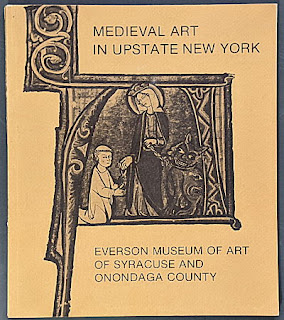
It reminded me that, in addition to an Otto Ege portfolio of "Fifty Original Leaves" (digitized here), the Buffalo and Erie County Public Library has some other interesting leaves and codices. I emailed the Library, and Amy J. Pickard, the Rare Book Curator, kindly and very promptly sent me reference images of all the leaves I enquired about.
In addition to a leaf from Ege HL 18 [1] in the "Fifty Original Leaves" portfolio (here), the Library has another leaf from the same manuscript, which we will come to shortly. The 90-leaf carcass of the parent volume was offered (but was apparently unsold) as part of the Ege estate at Sotheby's, 26 November 1985, lot 59 [2], and from this large portion it was possible to attribute the manuscript to "Flanders, possibly Ghent", because the litany includes numerous other Flemish saints, including Livinus and Bavo (who were important in Ghent) highly-placed.
Saturday, 9 January 2016
More on the 12th-Century Cistercian Missal Formerly Owned by Otto Ege

Sunday, 20 March 2022
Otto Ege's Psalter with 'Aves' (HL116)
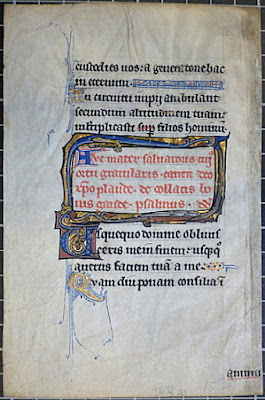
Many years ago, I worked on a group of early 13th-century English Psalters, some of which include a hymn or series of prayers to the Virgin in which each stanza starts with the word "Ave". So I took special notice when, in 2014, I encountered at the Philadelphia Museum of Art a leaf from a later 13th-century (c.1270) Franco-Flemish example, with the "Ave" stanza before each Psalm, curiously enframed in illuminated ornament, as in the image above.
Subscribe to:
Posts (Atom)