Wednesday, 26 January 2022

Another Unrecognised Budé Manuscript?

[I failed to do a blogpost this last weekend, so here is a quick one to fill the gap.]

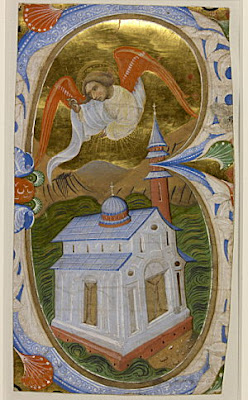
I hope to get to Portugal this summer, so I am looking through the Inventário dos códices iluminados até 1500, ed. by Isabel Vilares Cepeda and others (2 vols, Lisbon, 1994), to see if there are any libraries I ought to visit. In the first volume is an image of Lisbon, Biblioteca de Ajuda, 46-VIII-13, shown above.

Tuesday, 18 January 2022

Online Symposium in July: Fragmented Illuminations at the V&A

Readers of this blog may like to know about an online symposium that is being planned for July; details below.

You may also be interested to see that the website for the exhibition at the V&A has been expanded considerably over the course of the last couple of months to include new photographs of the installation and an ASMR video of the pages of a large 15th-century choirbook being turned; the latter has already been viewed about 130,000 times and generated lots of enthusiastic comments. (If the V&A website asks you to change your cookie settings and you prefer not to, you can experience the video at YouTube here). 

For those who have not yet seen it, the exhibition has now been extended until 5 June.

FRAGMENTED ILLUMINATIONS SYMPOSIUM - CALL FOR PAPERS

With over 2,000 manuscript cuttings, the Victoria and Albert Museum in London holds one of the largest collections of this kind in the world. Cut out of Italian, Germanic, Netherlandish, French, Spanish, and English manuscripts, they range from the 12th to the 18th century, with a wealth of 15th- and 16th-century examples. They vary in size, from small border snippets and initials to full leaves and, though they have come largely from choirbooks, other types of books are also represented.

The V&A will be organising an online symposium in early July as a follow-up to the display Fragmented Illuminations: Medieval and Renaissance Manuscript Cuttings at the Victoria and Albert Museum (extended until 5 June 2022). It will be held over one afternoon to allow for as large an audience as possible to join and participate, from different time zones.

We welcome papers focusing on any of the following themes and aspects, preferably in relation to pieces in the V&A collection:

  • Study of groups of cuttings from the same manuscript source
  • Provenance research and history of collections
  • Questions of attribution and iconography
  • Identification of parent manuscripts when extant; reconstructions of broken manuscripts
  • Materiality and digital display of manuscript cuttings: opportunities and challenges
  • Comparison with other types of intentionally cut-out medieval and Renaissance fragments, such as textile cuttings, cuttings from printed material, etc.
  • Relationship between manuscript cuttings and copies
  • 19th-cent reception of, and responses to, medieval and Renaissance illuminated manuscripts 

This list is indicative rather than exhaustive.

A preference will be given to contributions focusing on lesser-known examples in the collection and adopting innovative approaches.

Please send an abstract (max. 300 words), a paper title, and a short biography (max. 150 words) to c.yvard@vam.ac.uk.

Papers should be no more than 15 minutes in length, to allow time for questions and discussion.

The deadline for submissions is March 6, 2022. Selected speakers will be notified by mid-March.


Saturday, 15 January 2022

Murano Gradual Initials [I]

As regular readers will know, I have been interested in the so-called Master of the Murano Gradual for several years, despite knowing very little about Italian illumination. My interest in locating the surviving examples of his work perhaps go back to about 2014, when I first started to get interested in the 1838 Ottley sale (e.g. here), which included several. From 2016 I began to pass relevant images and bits of information such as auction-catalogue references to Stephanie Azzarello, who was doing her PhD on the artist and his manuscripts, and to Bryan Keene, who was also interested in the artist, as I had no intention of doing anything serious with the material myself. They have now collaborated on two articles published in the last few years:

Bryan C. Keene and Stephanie Azzarello, ‘Uno splendido enigma: Il Maestro del Graduale di Murano’, Alumina, 64, 2019, 14–21

Stephanie Azzarello and Bryan C. Keene, ‘Splendors of the Serenissima in a Digital Age: The Master of the Murano Gradual Reconsidered’, Manuscript Studies: A Journal of the Schoenberg Institute for Manuscript Studies, 6.2 (2021), 223–67 [1]

The second of these appeared very recently, and as it includes the most extensive list of the cuttings from the Murano Gradual, with their provenances, it has prompted me to sort through my miscellaneous notes, and I intend to blog a series of observations and thoughts, with a few corrections, additions, and questions, in the hope that they will also contribute to future studies.

One "correction" (if I am not myself mistaken) concerns the iconography of a cutting now at the Musée Cluny in Paris, shown above.

Saturday, 8 January 2022

Three "Jaquemart de Hesdin" Miniatures Resurface

I have written twice (in 2015 and again in 2016) about a series of miniatures (which have been attributed to Jacquemart de Hesdin [Wikipedia]), cut from a very interesting early 15th-century Parisian Book of Hours with unusual (unique?) prayers in French.

Sunday, 2 January 2022

Arthur Haddaway's Price-Code

Arthur Haddawy [Source]
Arthur Haddaway (1901–1981), of Fort Worth, Texas, is not well known as a collector of medieval manuscripts, although his library included the Hours of Charlotte of Savoy, among others:
Morgan Library, MS. M.1004 [Source]

Saturday, 11 December 2021

John Mathew Gutch (1776-1861) and the Choirbooks of the Venetian Lagoon

[Source]

John Mathew Gutch (1776-1861), shown above, is not known as a collector of illuminated manuscripts, although his "valuable and extensive library" is mentioned in his obituary [1], and his Wikipedia page

To students of Italian illumination he is, however, the former owner of an album (BL, Add. MS. 22310) containing nine full leaves from a Venetian Antiphonary attributed to the Master of the Donato Commission (here), and 23 cuttings.

Saturday, 4 December 2021

More Leaves from the Hastière Bible

I recently bought some books about Bohemian illuminated manuscripts, and illuminated cuttings in Bohemian collections, including one about the illuminated leaves, cuttings, and fragments at the National Gallery in Prague, shown above [1]. A few items caught my eye in particular.