Saturday, 10 December 2022

Another Leaf from the MdM and AdM Hours Found

Regular readers will know that I have been trying to trace leaves from a late 15th-century Book of Hours with unusual initials "MdM" and "AdM" in some of the margins (see here, here, and here).

One that has so far eluded me was reproduced in Maggs Bros., Catalogue 437: Books of Art and Allied Subjects (1923), no. 1159 plate LXI (of which a detail is shown above):

Saturday, 3 December 2022

A Breviary Written at Lucca in 1464

For a few years I have been aware of leaves of a Breviary (of which an example is shown above) which had a colophon with the name of the scribe, and the place and date of completion: Lucca on 22 December 1464. But searches for the terms BreviaryLucca, and 1464 produce surprisingly few hits for institutional websites: most of the search results are for online dealer listings. I hope this blogpost will make the manuscript better known and lead to new identifications.

Saturday, 26 November 2022

An Anonymous Auction in Paris in 1934

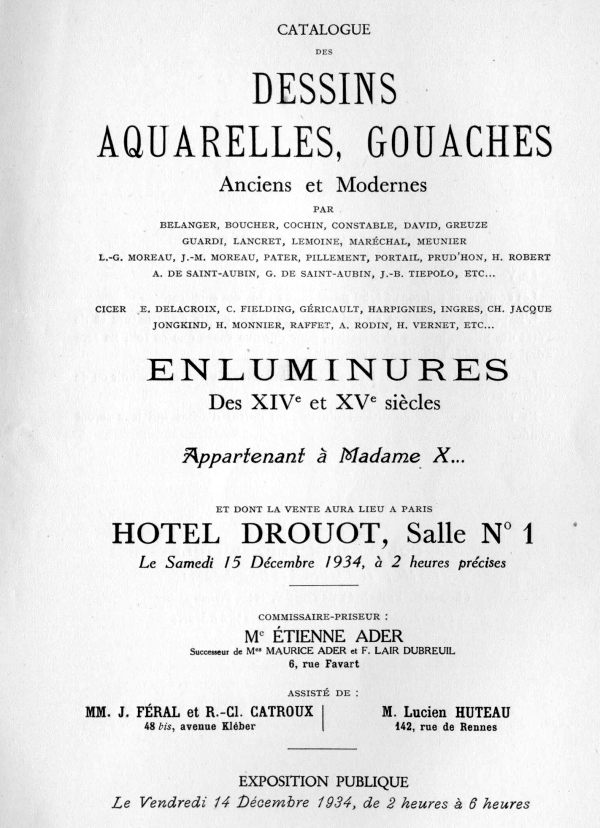
In a previous blogpost about "Another Hachette-Lehman-Yale Cutting" (here) I referred to the catalogue of an auction held in Paris in 1934, to which I did not have access at that time. I have now seen a copy, and it adds to the group of cuttings discussed in that blogpost.

Catalogue des dessins, aquarelles,
gouaches, anciens et modernes, ...
enluminures des XIVe et XVe siècles,
appartenant à Madame X ...
15 décembre 1934

Sunday, 20 November 2022

The Office of the Dead and the Iken Psalter

The Office of the Dead is a text whose overall format is pretty consistent, but whose details vary significantly, according to different liturgical "Uses". The Office can be found in several types of liturgical and devotional manuscripts, often appearing at or near the end of a Psalter, for example, and it is a standard feature of Books of Hours. It can be particularly helpful in establishing where a book was made (or at least where it was intended to be used) when the Hours of the Virgin are missing, incomplete, or correspond to a very widespread Use such as the Use of Paris or Rome. One might find, for example, a Book of Hours illuminated by Parisian artists, with a Parisian Use for the Hours of the Virgin, but an Office of the Dead for the Use of Troyes: a sure clue to the area where the patron lived.

Sunday, 6 November 2022

The Source of the Composition of a Fake Drawing

I am helping to catalogue the collection of leaves and fragments owned by the late Marvin Colker, which will be sold at Christie's in about a month's time. The collection contains lots of interest, and I have at least one more blogpost in preparation about items from it. Today I provide a very brief one, concerning the drawing above.

Saturday, 22 October 2022

Two More Leaves of the MdM and AdM Hours


In May I wrote a blogpost about two leaves from a Book of Hours which has the initials "MdM" and "AdM" -- presumably of its husband and wife owners -- in the borders; they are at Montreal and Rochester, NY. By chance I found another leaf from the same manuscript while in the US in July, in Toledo, Ohio, and wrote another blogpost about them after my return. In the second of these posts I reproduced a page from a 1923 Maggs Bros catalogue, in which four leaves of the manuscript are described, including the Toledo one. 

I have now found two more leaves, at least one of which is described in the Maggs catalogue. The two new leaves do not have the telltale initials "MdM" and "AdM" in their borders, but I am confident -- based on the style of script and decoration, and the number of lines per page -- that they come from the same manuscript.

Saturday, 15 October 2022

A New Leaf of the Quadripartite Miniatures Series (Paris, c.1340)

Perhaps the most exciting discovery of my summer trip to various collections in NY, OH, and Toronto was a wealth of unknown or little-known material at the Royal Ontario Museum. Among many interesting illuminated cuttings and text leaves is the quadripartite miniature shown above, a previously unrecognised member of a group of miniatures now scattered between private and institutional collections including the Lilly, Bodleian, and British Libraries, Fitzwilliam Museum, and Art Institute of Chicago.