Sunday, 17 April 2022

The Lehman Archive at The Met Museum

[This, and all but the first of the next 9 images below, are from the
Robert Lehman papers, Robert Lehman Collection,
The Metropolitan Museum of Art, boxes 73-76]

On my trip to the US before Christmas I spent a couple of days at the Watson Library of The Met Museum. My primarly purpose was to work through the files of the archive of Robert Lehman (1891-1969) [Wikipedia] relating to his collection of illuminations.

Sunday, 10 April 2022

Unnoticed Leaves of Ranulf Higden's Polychronicon

Latin Fragment D.1 (detail)
This and the following images reproduced by courtesy of the
Cadbury Research Library: Special Collections, University of Birmingham

I went to Birmingham last week to see the Crivelli exhibition. While in the city, I also went to The Barber Institute (to look at paintings, not manuscripts such as the Liberale da Verona cutting mentioned at the end of this post), and the University Library (because they have a very good set of Folio Society Collectors' Corner catalogues, some of which I have not been able to consult anywhere else), and the Cadbury Research Centre (Special Collections), which holds a large collection of little-known fragments. (And I do mean fragments, not cuttings and leaves). 

As usual, in my experience, about 90% of the fragments were unintersting to me (Canon Law, Sermons, Use of Sarum liturgica, etc.), but 9% are interesting and 1% are very interesting. One of the two or three items that comprise the 1% is an unrecorded portion of a copy of Ranulf Higden's Polychronicon  Wikipedia], of which a detail is shown above.[1]

Saturday, 2 April 2022

Cuttings by The Master of the Brussels Initials in the 1910 Stroganoff Catalogue?

In a previous post I showed that a cutting of an initial 'U' with St John the Evangelist by the Master of the Brussels Initials has the remains of the Stroganoff ink stamp on the reverse. Its dimensions were reported as 135×135mm when sold by Christie's in 2017. I suspect that it was lot 627 in the 1910 Stroganoff auction, and that the cataloguer mistakenly identified the evangelist as Luke instead of John:

"U. Ritaglio di corale decorato dalla figura dell'evange-lista Luca.
Contorno ed aureola dorata. Arte Umbra, secolo xv.
m. 0.13 × 0.13"
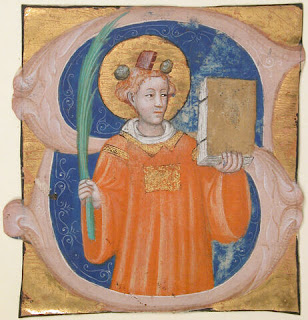
This hypothesis would be considerably strengthened if the preceding item, lot 626b, were the initial 'S' depicting St Stephen by the Master of the Brussels Initials, now belonging to The Met Museum, but the 1910 description is too vague to make a confident identification:

 
"S. decorata dalla figura di S. Stefano. Policromata e dorata"

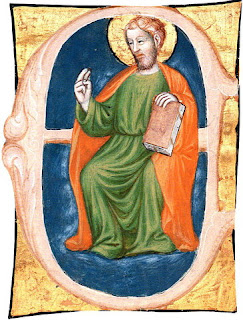
One more cutting by the Master of the Brussels Initials, certainly from the Stroganoff collection (because it has his ink-stamp on the reverse), might have been lot 621:

"O. Ritaglio di corale, con l'effige del Salvatore in atto
di benedire. Aureola dorata. Arte Umbra del secolo xv.
m. 0.95 × 0.10"
At  c.135×100mm this cutting is significantly taller than it is wide -- but far less tall than the 950×100mm reported in the Stroganoff catalogue. An initial more than 9 times taller than it is wide and nearly a metre tall, however, is almost impossible to imagine, which suggests that the dimensions printed in the Stroganoff catalogue are the result of a typographical error. It is also notable that the initial above is an 'E', while the catalogue describes an 'O'; yet such a confusion is easy to understand.

So, it may be that all three, two, one, or none of the above initials are described in the Stroganoff catalogue, and the above comments are therefore rather speculative: there are problems with all three identifications. I try to avoid indulging in unsupported speculation, and have little patience for other scholars' work when it is insufficiently founded on firm facts, but in the present case I think that there is a balance of probability in my favour, because two of the three cuttings above were definitely in the Stroganoff collection, and all three of their subjects as reported in the 1910 catalogue, namely:
  • an initial 'U' with an Evangelist with gilded halo and surround, c.130×130mm
  • an initial 'S' with St Stephen, in colours and gold
  • a cutting of an initial from a choirbook, with Christ Blessing

Saturday, 26 March 2022

The "Whitby" Psalter

As mentioned in the previous post, much of my earliest research on illuminated manuscripts concerned 13th-century English Psalters, and although I have not published much on the subject, I have always maintained an interest in them. I was therefore glad, several years ago, to be able to spend some time examining the so-called Whitby Psalter at the Houghton Library (of which an image is shown above).[1]

The Psalter is now very incomplete: the Houghton has a bound portion of just 28 leaves, but in the past several years I have found several more, and have long intended to do a blogpost. I found another recently, and this has spurred me into action.[2]

Sunday, 20 March 2022

Otto Ege's Psalter with 'Aves' (HL116)

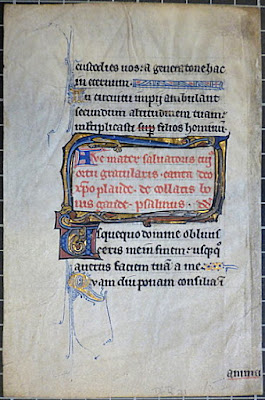
Many years ago, I worked on a group of early 13th-century English Psalters, some of which include a  hymn or series of prayers to the Virgin in which each stanza starts with the word "Ave". So I took special notice when, in 2014, I encountered at the Philadelphia Museum of Art a leaf from a later 13th-century (c.1270) Franco-Flemish example, with the "Ave" stanza before each Psalm, curiously enframed in illuminated ornament, as in the image above.

Sunday, 13 March 2022

The Antiphonal of Berardo da Teramo in 1924

When I was in New York at Christmas I spent some time at the Watson Library in the Metropolitan Museum of Art, mainly looking at the part of the Robert Lehman Archive pertaining to his illuminations. I'll be doing a separate post about it in due course, because it tells us a lot about when and where he acquired them, and explains the weird numbering of items that appears in de Ricci's Census.

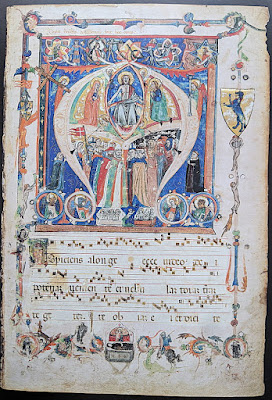
Today I'll just highlight one provenance discovery that came out of this work, relating to the Antiphonary of Berardo da Teramo (of which an image is shown above), one of the most important illuminated manuscripts from Abruzzo, of the second quarter of the 14th century.

Sunday, 6 March 2022

The Murano Gradual Initials [II]: The Minor Initials

There is a particular type of cut-out illuminated foliate initial which is found in many institutions, and of which examples appear on the market with some regularity. Once you have seen a few they are very easy to recognise, because although one may differ from another in their type of foliage, their formal and technical features are very consistent. The image above has been chosen to give a sense of their overall uniformity as well as variety of foliage-types (click the image to enlarge). Over the course of a couple of posts I intend to look at this large group of initials (I know of more than 200 of them [1]), and consider some questions they raise.

In 1994 Christopher de Hamel suggested that the initials came from the same manuscript as the well-known historiated initials cut from the Murano Gradual; he based this partly on details of their illuminated ornament, but mainly on the script of the text and music on their backs[2], and since then, they have regularly been described as having come from the Murano Gradual. The question of the parent volume has been addressed very recently. In 2019 Bryan C. Keene and Stephanie Azzarello offered some observations both for and against accepting de Hamel's proposal, but left the question open: 'further analysis of this entire group of illuminations is in order and will be part of a longer study'. In a recent article, having had the opportunity for further analysis, they concluded that "[the initials'] association with the Murano manuscripts does not seem likely", and pointing to evidence that "aids in disassociating De Hamel’s group of initials from the Murano series".